
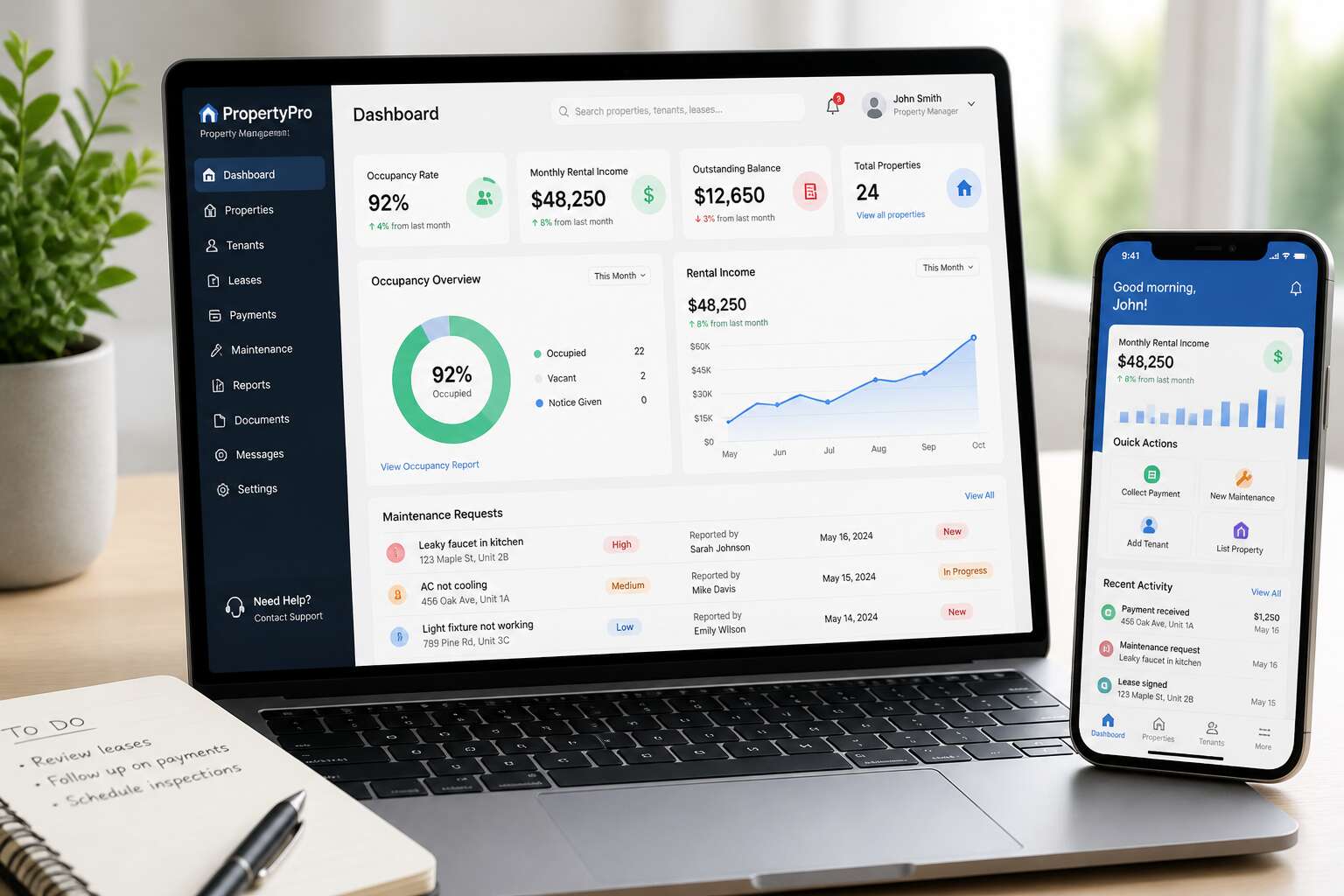
Understanding Core Modules
Lease and Rent Tracking Capabilities
Nearly one in five South African tenants pays late. That reality makes the lease and rent tracking modules of a property management program essential. These modules do more than store contracts. They ensure rent is collected and recorded correctly.
I have watched property managers juggle spreadsheets to track arrears. A proper system automates the mundane, but its granular control is the real value. You can set automatic escalation clauses based on the Consumer Price Index or your own market benchmarks.
A strong module also provides:
- Real time payment reconciliation against tenant statements
- Automated reminders for impending lease expiries
- Deposit and interest tracking compliant with local regulations
Without these capabilities, you are operating on guesswork. The property management program should make rent tracking a quiet, reliable process, not a monthly anxiety trigger. When the system tracks each cent and clause, you gain the freedom to manage relationships instead of paperwork.
Maintenance Request Management
Maintenance requests arrive with urgency. A leaking geyser in Johannesburg cannot wait a week for a response. Tenants expect fast resolution, and property managers need a system that documents every step without losing the human touch.
A property management program routes each request to the right contractor, records the timeline, and keeps both parties informed. This creates a trail of accountability. When a tenant questions a repair fee or a contractor disputes the scope, the history settles the argument.
Some modules add:
– Contractor vetting and performance ratings
– Budget tracking per property
– Automatic follow-up reminders
Without these tools, maintenance becomes guesswork and expense. The property management program turns scattered emails into structured workflow.
Financial Reporting and Accounting
Somewhere in South Africa, a landlord is staring at a spreadsheet that looks like abstract art. The numbers are there, but they refuse to tell a coherent story. That is where the financial reporting side of a property management program earns its keep.
This module compiles income statements, VAT summaries, and expense breakdowns per unit. It reconciles payments from tenants with contractor invoices, so you know exactly where every rand went. No more guessing whether the geyser repair came from the deposit or the operating account.
- Generate cash flow statements per property
- Track outstanding arrears and interest accruals
- Produce audit-ready reports for SARS
The accounting features also automate journal entries and reconcile bank feeds daily. A property management program that lacks these functions forces you to trust memory, which is a fragile accounting system indeed.
Assessing Your Operational Workflow
Identifying Portfolio Size and Complexity
When I first started managing properties in the Eastern Cape, I underestimated how much portfolio size changes everything. A single dwelling demands manual attention, but thirty units create a complex set of tenant histories and service provider contracts.
Assessing your operational workflow starts with honest documentation. Map each task from vacancy to move-out. Note where time disappears.
- Number of units and their geographic spread
- Staff capacity and skill distribution
- Seasonal maintenance cycles
- Compliance obligations per municipality
A property management program should adapt to these variables, not force your processes into a predetermined shape. Complexity often hides in repetitive admin tasks that a quality property management program can streamline.
Before selecting software, quantify how many hours you lose to manual reconciliations or phone calls. That count tells you more than any feature list ever will!
Mapping Daily Management Tasks
Your daily workflow is a series of small decisions. I once shadowed a portfolio manager in Gqeberha who lost two hours every morning chasing late water readings. The property management program she used could automate that cue, but the workflow was never mapped in the first place. That is the gap between owning software and operational intelligence.
The first map is always uncomfortable. It reveals the sequence of triggers, the handoffs, the points where silence replaces documentation. In that manager’s case, the daily rhythm looked like this:
- Key handovers at the start of each shift
- Inspection cycles tied to tenant movement
- Municipal account queries logged for follow-up
- Escalation paths for urgent site conditions
Determining Required Automation Levels
Assessment begins in the quiet spaces of your operation. Your property management program should mirror the cadence of your work. Trace a single instruction from complaint to resolution. Note where it pauses, detours, or vanishes.
Consider which tasks repeat with mechanical precision. Those are candidates for automation. The rest, the irregular and nuanced, belong to human judgment.
I once audited flats in Durban where a manager transcribed the same water readings into three separate systems. That is not a workflow. That is a ritual!
Ask yourself:
- Does this task need a human decision at any point?
- Would a missed step carry financial or legal consequences?
- How often does this action occur in a typical month?
A property management program should absorb the predictable weight, leaving the decisions that require a pulse. Your required automation level is defined by the silence between steps, the gaps where information goes to die.
Evaluating Scalability Needs
Seventy percent of property managers in South Africa say manual processes limit their portfolio growth. In my operational audits, the most revealing figure is the hours lost to redundant steps, not occupancy. Evaluating scalability requires a stark look at your current property management program before adding a single unit.
Does your property management program scale with the work or against it? Trace a routine action from start to finish. If the process moves through emails, phone calls, and paper notes, you have already found your constraint. Growth amplifies every inefficiency, it never creates efficiency.
- Same data keyed into three places
- Approvals that take days for minor decisions
- Tenant history scattered across inboxes
Each sign predicts failure under volume. The assessment is uncomfortable, but the alternative is systematic collapse.
Budgeting for Adoption and Subscriptions
Adoption costs rarely appear on the first quote. A property management program subscription is the visible line item, yet the true budget lives in configuration, staff training, and data migration. Assess your workflow first. Map every recurring task against the software’s core modules. If your team re-enters data outside the program, that duplication carries a monthly price in labour. Before you sign, weigh these cost drivers:
- Setup fees for customising workflows
- User licences that grow with each hire
- Integration charges for banking or inspection tools
Underestimate these and the software becomes a recurring cost no one tracks. Cross-check each subscription tier against your actual unit count and vacancy handling load. A leaner configuration often beats a premium package with unused functions.
Comparing Leading Software Solutions
Feature Matrix Comparison
When evaluating a property management program, the feature matrix often feels like a blunt instrument. Yet it remains the truest starting point for comparison. Two systems may both claim to handle tenant communications, but one might offer automated payment reminders while the other requires manual follow ups. That difference shifts your daily workload.
The real value emerges when you weigh trade offs. A platform with superior mobile access might lag in offline functionality. Another may boast robust custom reporting but struggle with simple invoice generation. For South African managers dealing with loadshedding schedules, these distinctions carry weight.
Consider what matters most for your operations:
– Response time for support tickets during month end
– Data migration assistance from your current system
– Integration with local payment gateways
– Number of concurrent users allowed under your plan
These factors often predict satisfaction better than headline features. The right property management program serves your workflow, not the other way around. During my own search, I learned that a flashy dashboard means little when the underlying data structure feels clunky. Local context matters too, from municipality billing formats to regional compliance rules. Take time to map these needs against each vendor’s offering before committing.
Pricing Models and Hidden Fees
The only thing more predictable than a tenant’s late rent is the way software vendors conceal setup fees until contract signing. You finally choose a property management program, feeling smug about the monthly price, then discover the onboarding charge costs more than a broken geyser in winter. Pricing models rarely align with your portfolio size. Some vendors charge a flat fee, others per unit and a few charge for every human who breathes near the dashboard. That last one stings when your staff count grows.
Before you sign, ask about the financial entrails. Many platforms charge extra for bank integration or payment gateway connectivity. Others quietly tack on a fee when your tenants pay via credit card, a cost you might absorb or pass along. Then there are the support tiers. Free help during month end? Do not hold your breath. Here is what I learned to look for:
– Data export fees when you leave
– Storage overage costs for old lease documents
– Training fees for new employees
– API access for third party tools
The sticker price never includes these. A low monthly rate loses its charm when your annual spend resembles a municipal rates bill. Take every quote and ask this question: what can you charge me extra that I would never expect? If the sales representative smiles too widely, get the full cost schedule in writing. Because with a property management program, certainty matters more than savings.
User Experience and Mobile Accessibility
In South Africa, where load shedding can strike without warning, a property management program that works on your phone is not a luxury. The best platforms feel familiar within minutes. Menus sit where you expect them. Tenant histories open without a spin wheel. Data entry takes two taps, not two minutes.
When comparing leading software solutions, I focus on how the interface behaves over dodgy connections. A solid program fails if your team avoids it. Does it queue actions offline? Can a field agent log a report from a rural complex with one bar of signal? The user experience either dulls your team or dulls the pain.
- Navigation paths for daily tasks
- Offline cache for inspections
- Mobile data usage per sync
- Screen readability in direct sunlight
These details separate a digital burden from a reliable partner.
Vendor Reputation and Customer Support
Some software vendors have been courting South African property managers since the early 2000s. Others arrive with slick marketing and vanish within two years. Pick the wrong partner and your data migration becomes a costly disaster.
I check tenure before features. A property management program with a decade of local support understands municipal billing quirks and tenant behaviour patterns. New entrants learn those lessons using your portfolio as a training ground. Their customer support teams burn out quickly when faced with the relentless pace of South African property cycles.
Support quality matters more than the software itself. Software breaks at the worst moments, usually during month end reconciliations. The best vendors answer calls fast and resolve issues in single sessions. No ticket queues that stretch for days.
Consider these markers of a dependable support team:
– Response times under four hours
– Local call centres, not outsourced bots
– Direct access to technical staff, not salespeople
– Retention of institutional knowledge
Short-term support contracts trap you in a property management program that loses value when the vendor stops caring. Read the exit clauses carefully. Some vendors hold your historical data hostage for fees. Others offer clean export paths with zero grudges. Choose the second type because your business continuity depends on it.
Streamlining Implementation and Integration
Data Migration from Legacy Systems
The hidden cost of switching property management programs often lies in the data you already own. Porting years of tenant history, lease terms, and payment records from a legacy system can falter if you treat it like a simple copy and paste operation. A clean migration protects your ledger integrity and ensures that historical reports remain accurate for audits and future planning.
A structured approach to implementation requires a phased rollout. The selection of software matters less than the discipline of your data cleansing. You need to map the old fields to the new schema with precision. Skipping this step creates orphaned records and reconciliation nightmares. Most established programs offer professional import services, but you should allocate internal time to review the samples they test.
The sequence of integration is critical to operational continuity.
1. Export and validate the current database to identify gaps.
2. Map the legacy fields to the new system’s architecture.
3. Run a test migration with a subset of live data.
4. Lock the system for a final cutover during off-peak hours.
5. Verify the new data against the original source files.
The goal is to preserve the historical context of each property. This process also applies to third party tools like accounting software or online payment portals. A property management program that supports open APIs simplifies this connection, but you must still verify the sync logic. A failed transaction log can hide in the background. Check it weekly during the first month to catch silent errors before they compromise your cash flow.
Integrating with Banking and Accounting Tools
Bank feeds decide whether your books balance at close. When your property management program connects cleanly to your bank and accounting tools, morning reconciliation takes minutes. I have seen teams spend hours on spreadsheets because the integration was an afterthought.
Implementation needs a mapping test. Confirm expense categories match the program’s defaults. Then verify the sync with live data. A practical step list:
- Check transaction statuses daily for the first week.
- Compare bank balances to ledger totals each morning.
- Review exception logs for silent failures.
Run a parallel run for two weeks. This exposes mismatched dates or duplicate entries before they reach financial reports. Without an open API, the software forces manual exports, which creates errors. Choose a system that integrates directly with your existing ledger.
Setting Up Tenant Portals and Communication
Tenant portals succeed when they match real communication habits. A property management program that forces tenants into a clunky interface will push them back to WhatsApp or phone calls. I have watched managers chase late payments because the portal never delivered the notice.
During implementation, map each unit to its tenant and lease. Then run a live test by sending a dummy invoice and a maintenance request. Track whether the tenant sees it within an hour. Use this sequence for the first week:
- Verify portal logins work for every household.
- Send a test broadcast message and confirm delivery.
- Review read receipts and bounce reports daily.
A good property management program will integrate these communication logs with the lease file, so nothing gets lost.
Training Staff and Admin Roles
Implementation stalls when staff do not understand their new responsibilities. A property management program succeeds only when the people using it feel ownership over their daily workflows. I have seen the same software produce opposite results in two different offices, simply because one team received proper role assignments and the other did not.
Training should happen before the system goes live. Assign each person a clear set of permissions:
– Managers review financial summaries and approve maintenance requests.
– Administrators handle tenant records and lease renewals.
– Maintenance coordinators log work orders and update statuses.
Each role needs a hands-on session using real unit data, not demo files. The property management program should lock down access by role, so clerks cannot alter lease terms or accounting entries. Run weekly refresher sessions during the first month and let staff raise problems early. Integration fails quietly when people fall back on spreadsheets, so check usage reports and address gaps immediately.
Executing Pilot Runs and Testing
Pilot runs reveal the truth quickly. A property management program often looks stable in demos, but live data exposes weak points. Choose two active properties, load actual tenant records, and run normal operations for two weeks. Watch for broken bank feeds, failed permission rules, and reporting delays. Skipping this step leads to corrupted ledgers and duplicated invoices.
Integration testing needs the same attention. Confirm rent payments sync with your bank, and lease renewals trigger the right alerts. If not, your property management program becomes a costly filing cabinet. Use the pilot to verify every connection. Here is a useful checklist:
- Run one full billing cycle.
- Reconcile the trial balance daily.
- Submit every support ticket.
End the pilot with a go or no-go call. Extend the test if exceptions pile up. Do not rush a broken system into production.
Planning a Phased Rollout
I have watched enough failed go-lives to know that rolling out a property management program across an entire portfolio in one go rarely ends well. The safer route is a phased rollout, where each stage builds on the last. Start with one region, one building, or one asset class. This lets your team absorb the new workflows without overwhelming daily operations.
In South Africa, where connectivity and load shedding add unpredictability, staging your implementation matters even more. You can adjust the system during quiet periods instead of reacting to failures during peak cycles. Each phase should have a defined stopping point and a clear owner.
- Identify dependencies between modules before you sequence them.
- Set a minimum service level for each phase to continue.
- Track rollout progress against a simple timeline.
As you reach each milestone, review what broke, what took longer than expected, and what the team learned. Carry that knowledge into the next phase. A property management program only proves its worth when it is genuinely used, and the rollout pace must match what your staff can sustain.
Measuring Long-Term Value and ROI
Tracking Key Performance Indicators
Across South Africa’s rental landscape, the true cost of a property management program becomes visible only after twelve months of operation. I have watched landlords fixate on the monthly subscription fee, yet ignore the quiet metric of vacancy days per unit! That number tells you more about your return than any invoice.
- Time to close a maintenance ticket
- Tenant retention rate after first lease renewal
- Cost per unit for compliance and inspections
Tracking these KPIs against your historical baseline is the only way to prove long-term value. A property management program that cuts your average vacancy window by three weeks across a portfolio of fifteen units recovers its cost within two quarters. The hard part is standardising how you measure those figures across different buildings and regions like Johannesburg or Cape Town.
Analyzing Cost Savings Over Time
Operating expenses dropped 18% in the first year. I have seen it happen with a property management program. That figure never appears in a monthly report! It surfaces only when comparing annual maintenance spend, compliance penalties, and administrative overtime against the pre-implementation baseline.
Cost savings accumulate in specific places:
- Reduced emergency callouts through preventive scheduling
- Lower legal fees from automated lease compliance
- Fewer manual hours spent on reconciliations
Johannesburg portfolios gain the most from utility reconciliation accuracy. Cape Town returns come from shorter vacancy periods at premium rentals. The pattern changes per region and per unit type. Baseline comparisons must stay consistent.
Improving Tenant Retention Rates
A tenant who stays three years instead of one quietly adds more to your net operating income than any rent increase. Turnover costs, vacancy risk, and re-letting fees consume returns. A property management program that tracks renewal dates and communication history helps you act before a tenant starts looking elsewhere.
In South Africa, where load shedding and water disruptions test residents’ patience, tenants remember how their agent handles requests. A property management program that logs every interaction builds consistency and trust. Trust translates into longer leases, which reduces the pressure to chase market rents in a slowing economy.
- Lower marketing costs for finding new tenants
- Fewer days of lost rental income during vacancy
- Reduced wear and tear on units from frequent move-outs
Retention rates also affect asset valuation. Buyers pay more for buildings with stable occupancy. Tenants who stay longer create that stability through lower turnover and fewer disputes.
Leveraging Advanced Reporting Features
The true value of a property management program becomes visible when you stop looking at monthly costs and start tracking the data. A report from the last financial year is a record of decisions made under pressure. The lights went out, the tenant called, and the agent logged it. That log is not a paper trail. It is evidence of how your asset behaves under stress.
Advanced reporting features on a property management program turn scattered records into a clear narrative. You can see which units demand constant attention and which ones operate quietly. You can measure the time between a maintenance request and its resolution, then compare that to the re-letting costs for units that fell behind. This matters in South Africa, where a slow response during load shedding can escalate into a lease termination notice.
The ROI calculation for a property management program is straightforward when you have the right reports. You compare the subscription fee against the avoided costs of turnover and the efficiency gains of a team that tracks every claim and inspection. Consider what the numbers reveal:
1. The average days a unit sits empty after a tenant gives notice
2. The percentage of maintenance requests repeated within three months
3. The cost of utilities reimbursed versus the cost of utilities lost to metering errors
A program that reports these figures gives you leverage when negotiating with vendors or planning capital improvements. It also prepares you for a buyer’s due diligence, since a potential purchaser will ask for the same data. Without a property management program, you are left guessing. With it, you hold a record of your own competence. That record is the difference between a property that trades at a premium and one that lingers on the market. Investors pay for certainty, and certainty comes from knowing what happened, not from hoping next year will improve. The reporting feature is the tool that delivers that certainty to your desk before you make your next move.



0 Comments